
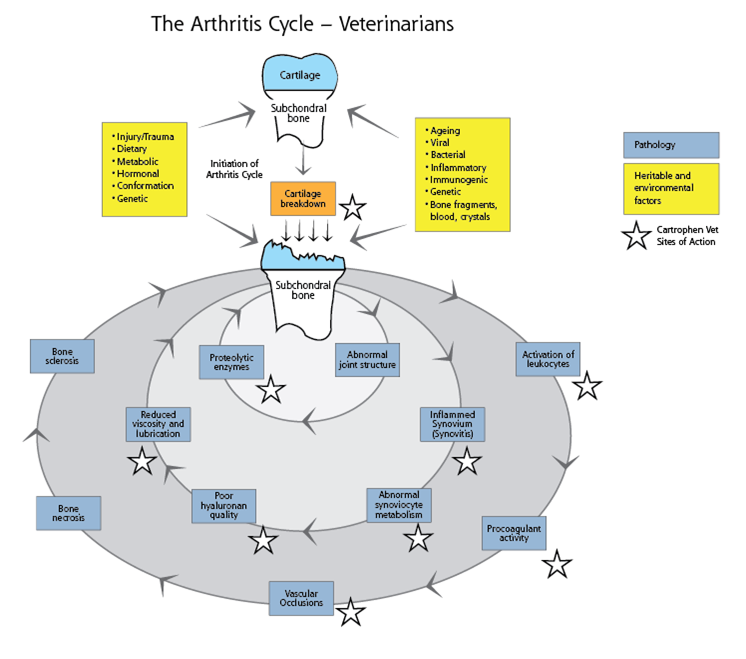
Cartrophen Vet (100mg/mL of pentosan polysulfate sodium or PPS) is a treatment for osteoarthritis (OA, also known as degenerative joint disease or DJD) and related musculoskeletal disorders in dogs and horses. It provides pain relief by acting on the pathology within the joint that causes pain and lameness. Cartrophen Vet has many sites of action within the underlying processes of the arthritis disease which helps maintain joint health including preserving joint cartilage. It is therefore classified as a disease modifying osteoarthritis drug (DMOAD).
Cartrophen Vet is a prescription only, injectable, polysulfated polysaccharide of plant origin.
Cartrophen Vet will benefit acute through to chronic OA due to the progressive nature of this disease. Early intervention with Cartrophen Vet in acute injuries will maximise the restoration of normal connective tissue function.
With 20% of dogs over one year of age suffering from OA and 60% of lameness in the horse related to OA, Cartrophen Vet and DMOAD represent the rational approach to the medical treatment of OA.
The effective dosing and dosage regimen is discussed in ‘Dosage & Usage’
How does Cartrophen Vet work?
Cartrophen Vet is a treatment, which has activity that works to correct the underlying metabolism of the OA. By re-balancing the metabolic processes it preserves joint health and subsequently provides relief from the clinical signs of OA. Cartrophen Vet’s changes to the disease are evident in its long-term effects. Benefits are received well beyond the treatment period of 4 weeks with repeat treatments in some cases at one-year intervals. Cartrophen Vet has shown to be effective in 80% of dogs treated, further discussed in ‘Safety&Efficacy‘.
Cartrophen Vet has been shown to exhibit the following modes of action:
- Stimulates cartilage production – Stimulates chondrocytes to synthesize cartilage matrix
- Improves the quantity and quality of synovial fluid – Stimulates synoviocyte biosynthesis of hyaluronan, improving both the quantity and molecular weight
- Stimulates stem cell activity and cartilage cell differentiation – Promotes Mesenchymal precursor cell (MPC) proliferation and cartilage cell differentiation. Importantly, this is relevant with the frequency of MPCs elevated in arthritic cartilage
- Increased blood supply and nutrition to the joint and subchondral bone – Mobilizes thrombi and fibrin deposits, lipids and cholesterol in synovial tissues and subchondral blood vessels in order to allow increased blood flow to key areas of the synovial joint.
- Strong anti-inflammatory properties – The potent anti-inflammatory activities of PPS have been consistently demonstrated in different models of severe inflammation
- Inhibits cartilage degrading enzymes – The collagenase catabolic enzyme is inhibited by the stimulation of tissue inhibitor metalloproteinase
- Increased production of free radical scavenging enzymes – Stimulates free radical scavenging enzymes superoxide dismutase and lipase
- Stimulates important growth factors that promote cartilage growth – Increases the production of the essential trophic factor for cartilage, insulin-like growth factor-1 (IGF-1), which stimulates incorporation of sulfate and encourages cartilage growth
- Affinity for cartilage – The strong binding of the drug to cartilage protein results in therapeutic concentrations for up to 4 days (Data on file Biopharm Australia Pty Ltd)
- Inhibits and modulates a range of noxious substances – such as pro-inflammatory mediators, bio-active amines such as: histamine, serotonin, superoxide free radical, enzymes such as elastase, hyaluronidase, cathepsins, THF-α converting enzyme (TACE) and proteins of the complement system which are implicated in the degradation of the cartilage matrix components
 For clinical aids and further information visit our download page
REFERENCES
Click to view referencesAlsalameh S, Amin R, Gemba T, and Lotz M (2004) Identification of mesenchymal progenitor cells in normal and osteoarthritic human articular cartilage. Arthritis Rheum. 2004 May;50(5):1522-32)
Bouck GR, Miller CW and Taves CL (1995). A comparison of surgical and medical treatment of fragmented coronoid process and osteochondritis dissecans of the canine elbow. V.C.O.T. 8: 177-183
Bowman L, et al. (1994) Calcium pentosan polysulphate (CaPPS) stimulates release of superoxide dismutase (SOD) from endothelium in vitro and in vivo. Int. Soc. Free Radical Res., 7th Biennial Meeting 1994
Brunaud M et al (1967) The clearing effect of xylane sulfate polyesters on plasma lipids. Progr Biochem Pharmacol 3:393-402
Caron J, Genovese L. in Diagnostics and Management of Lameness in the Horse 2003;746-763.
Clemmons DR, Busby WH, Garmong A, Schultz DR, Howell DS, Altman RD, Karr R (2002). Inhibition of insulin-like growth factor binding protein 5 proteolysis in articular cartilage and joint fluid results in enhanced concentrations of insulin-like growth factor 1 and is associated with improved osteoarthritis. Arthritis Rheum. 46(3): 694-703
Cullis-Hill D and Ghosh P (1994). Joint Convention of L’Ordre des. Medicins veterinaries du Quebec and the Canadian Veterinary Medical Association, Quebec City, Canada, July 6-9
Francis DJ, Hutadilok N, Kongtawelert P, Ghosh P (1993) Pentosan polysulphate and glycosaminoglycan polysulphate stimulate the synthesis of hyaluronan in vivo. Rheumatol Int 13:61-64
Francis DJ and Read RA (1993). Pentosan polysulphate as a treatment for osteoarthritis (degenerative joint disease) in dogs. Aust. Vet. Practit. 23(2):104-109
Ghosh P and Cheras PA (2001). Vascular mechanisms in osteoarthritis. Best Pract. Res. Clin. Rheumatol. 15(5): 693-710
Ghosh P. (1999) The pathobiology of osteoarthritis and the rationale for the use of pentosan polysulfate for its treatment. Seminars in Arthritis and Rheumatism 28(4):211 267.
Ghosh P, Wu J, Shimmon S, Zannettino A, Gronthos S, Itescu S (2010) Pentosan polysulfate promotes proliferation and chondrogenic differentiation of adult human bone marrow-derived mesenchymal precursor cells. Arthritis Research & Therapy, 12:R28
Hegemann N, Kohn B, Brunnberg L, Schmidt MF (2002) Biomarkers of joint tissue metabolism in canine osteoarthritic and arthritic joint disorders. Osteoarthritis Cart. 10, 714-721
Hutadilok N, Ghosh P, and Brooks PM (1988) Binding of haptoglobin, inter-a-trypsin inhibitor, and a, proteinase inhibitor to synovial fluid hyaluronate and the influence of these proteins on its degradation by oxygen derived free radicals. Curr. Ther. Res. 4: 845-860;
Klocking H-P and Markwardt F (1986). Release of plasminogen activator by pentosan polysulphate Thromb. Res. 41: 739-744
Little C and Ghosh P.(1996) In: McIlwraith CW and Trotter GW editors. Joint Disease in the Horse. WB Saunders Company, Philadelphia, 1996: 281-292.
Read RA, Cullis-Hill D and Jones MP (1996). Systemic use of pentosan polysulfate in the treatment of osteoarthritis. J.Small Anim Pract. 37: 108-114
Rogachefsky RA, Dean DD, Howell DS, Altman RD (1993) Treatment of canine osteoarthritis with insulin-like growth factor-1 (IGF-1) and sodium pentosan polysulfate. Osteoarthritis Cart 1:105-114
Smith JG, Hannon RL, Brunnberg L, Gebski V, Cullis-HiII D (2001) A Randomised double blind comparator clinical study of the efficacy of sodium pentosan Polysulfate injection and carprofen capsules in arthritic dogs, Journal of the Osteoarthritis Research Society International, 9(b):S21-S22
